Druid's Haven case study: teaching biodiversity with a tower defense
7 Oct 2026 · Druid's Haven
Tower defense is a genre about not letting things through. Druid's Haven is a tower defense where your towers are plants, the plants need each other to survive, and the best defense turns out to be variety. The design problem was making players discover that, a true thing about how ecosystems work, by playing instead of being told.
I was one of three game designers on a remote team of eight, as part of IndieCade's game design internship for the Climate Jam 2026. This is the case study: the problem, how I approached it, what I designed, and what changed on the way to shipping.
- Role: Game designer, one of three on the team
- Team: 9 people, remote
- Time: 6 weeks, four sprints, on the theme Plant a Seed!
- Engine: Unity, for web and Windows
- Tools: Google Docs, Trello, Git
- My part: Plant types, the biodiversity system, the seed economy, and the design documents the team worked from
- Result: 3rd overall out of 50 entries and Most Releasable Game, IndieCade Climate Jam 2026
- Play it: Druid's Haven on itch.io
The problem
On paper, tower defense and biodiversity don't have much to say to each other. The genre rewards a strong position and a lot of firepower. Biodiversity is the opposite: lots of different organisms, none of them strong alone, surviving because no single threat can take them all out at once.
So I set three goals for the design:
- Make the lesson playable. A player who loses a level because they planted nothing but oaks is more likely to remember why than one who read a tooltip.
- Make them feel capable, not guilty. Instead of a message that nature is dying and it's their fault, I wanted players to leave believing that small actions add up.
- Fit it in six weeks. The core had to be small enough to survive a sprint schedule, because a lot of the rest wouldn't.
Goal three is the unglamorous one. Spoiler: it comes back.
Homework first
I had only played a handful of tower defense games before this, so I started with homework. I played a few more, shared the takeaways with the team, and used them to shake our assumptions about what the genre has to be. It worked: we started from The Last Spire's stationary tower and ended up with an ecosystem that grows outward from a starting point.
The other half was IGDA's Environmental Game Design Playbook, which became a cornerstone of the design. It splits the job in two. Environmental knowledge comes from basing the game on how the real world works, so plants need water and nutrients. Environmental self-efficacy comes from giving players real-world analogues to act with, so a building that heats up the plants around it should be something the player can green. I also anchored the design document in reconciliation ecology, the science of making human-dominated places work for wildlife. The longer write-up is here.
Variety = resilience
Step one was defining the word, because "biodiversity" is something everyone nods at and nobody can build from. It means variety at three levels: individuals of a species differ (genetic diversity), several species share an area (species diversity), and different ecosystems exist across a region (ecosystem diversity). I scoped the game to the first two and gave each one a mechanic, on a tile-based map where every tile has water, nutrients, light and heat.
- Genetic diversity became randomized stats. Every plant rolls its stats within a range, so an oak might have anywhere between 100-150 HP and its own resistance to heat and blight. Two oaks are never quite the same oak.
- Species diversity became roles and neighbors. Plants fall into three archetypes: engineers that prepare the land, support plants that improve it, and deterrents that protect it. Different species planted next to each other buff one another, so the payoff for variety shows up right away.
- Resilience became the test. Harsh conditions like heat and disease travel across the map, and every so often a cataclysm goes after a single species. A disease arrives. It targets oaks. Most of them die, and the few that rolled high on resistance don't. If oaks were all you planted, you lose the level. If you planted other trees too, you survive.
The randomness isn't flavor, it's the lesson: the survivors are the ones that were different. It was also the smallest system I could find that shows all three ideas at once.
Ten plants, three jobs
I based Druid's Haven's first ecosystem on a real place, the Oak Woodland of the Mediterranean climate, because it's familiar to a lot of people and it's what most people picture when they picture "nature". Then I designed ten species for it, from Blue Oak and Coyote Brush to Lupine and Toyon. Each one is a small bundle of rules: what it needs to survive (some mix of water, light and nutrients), the stat ranges it rolls, what it does for the tiles around it, and how that grows at levels 2 and 3. A Blue Oak, for example, cools the tiles around it and throws shade over a wider area, while Lupine feeds the soil of its neighbors.
The point of a roster like this is that every plant needs something and gives something, so no plant is enough on its own. I sorted them into engineers, support and deterrents, with a few that also call in pollinators, birds and small mammals to fight for you, and planned to color-code the archetypes so that a player can tell roughly what a plant does from its color before reading a word, even when more ecosystems get added.
The message is the mechanic
Druid's Haven has one thing to say: variety keeps an ecosystem alive. I didn't want the game to say it out loud, because a sentence in a tooltip is easy to read and just as easy to forget. I wanted a player to find out by planting a field of the same tree and watching what comes for it.
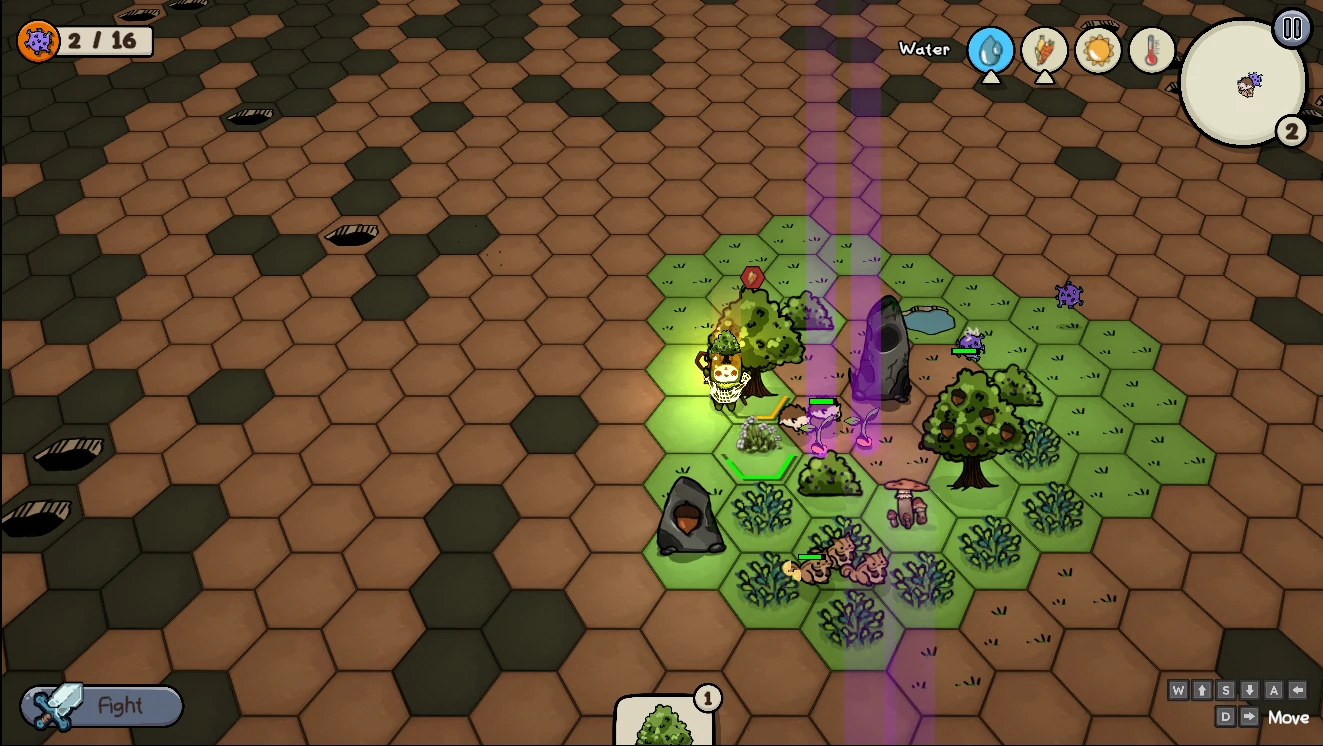
So the lesson lives in the rules. In my design, a disease goes after one species and a monoculture can't survive it. In the build we shipped, the same idea shows up as infection: plants of the same type clustered together spread it, and it spawns more enemies. Nobody has to explain why that matters.
Where the game does speak, I wrote the tone down in the design document: a Druid who is hopeful and persevering, planting through a bad situation instead of lecturing about how it got that way. The build backs it up visually: the land stays dark and barren until you plant, then goes green around what you planted. Not guilt, not doom, but a character who believes small actions add up, so the player gets to believe it too.
Seeds: the root of most of my problems
Druid's Haven runs on seeds. They are how you get new plants, and they were our only resource, which made them both the economy and the reward. Once the game moved from separate levels to an endless mode, where new seeds come from became the central problem, and it went wrong in two opposite directions.
First, the soft-lock: if a plant is wiped out, its seeds go with it, and you can never get that plant back. Second, the runaway: if plants drop seeds that become plants that drop seeds, the numbers grow exponentially and the challenge disappears. The economy had to live somewhere between a dead end and a snowball.
My first answer was a seed vault at the center of the map. It holds two seeds of every plant and restocks on a long cooldown (about 300 seconds, counted only during waves), so a bad event can wipe out a species without ending your run. On top of that, each plant grows seeds of its own kind on a timer, and every connection to a different species shortens that timer. Since seeds were our only reward, where they come from is a statement about what we want players to do, and I wanted the answer to be "plant variety".
That left the runaway, and the fix was a sink. My main proposal was to make seeds a currency as well as a resource: you can plant them or spend them in the vault on units and upgrades, so a player with too many seeds has a decision to make instead of a pile to ignore. I also wrote up a second, more magical direction (the plants have forgotten how to make seeds, so the Druid pays in energy) and laid the alternatives side by side with their trade-offs, so the team could argue with the reasoning and not just the answer.
What shipped, and what changed
Most Releasable Game looks at how polished and shippable a project is, so it's as much a compliment to the programmers and artists who built it as to the design. A design document written before the first prototype is a hypothesis, and six weeks is a rigorous test. Here is how mine held up.
What made it in
- The loop. "Plant, survive, grow" is still the game, and seeds are still how you grow: you collect the dropped seeds each round to get new plants for the next one.
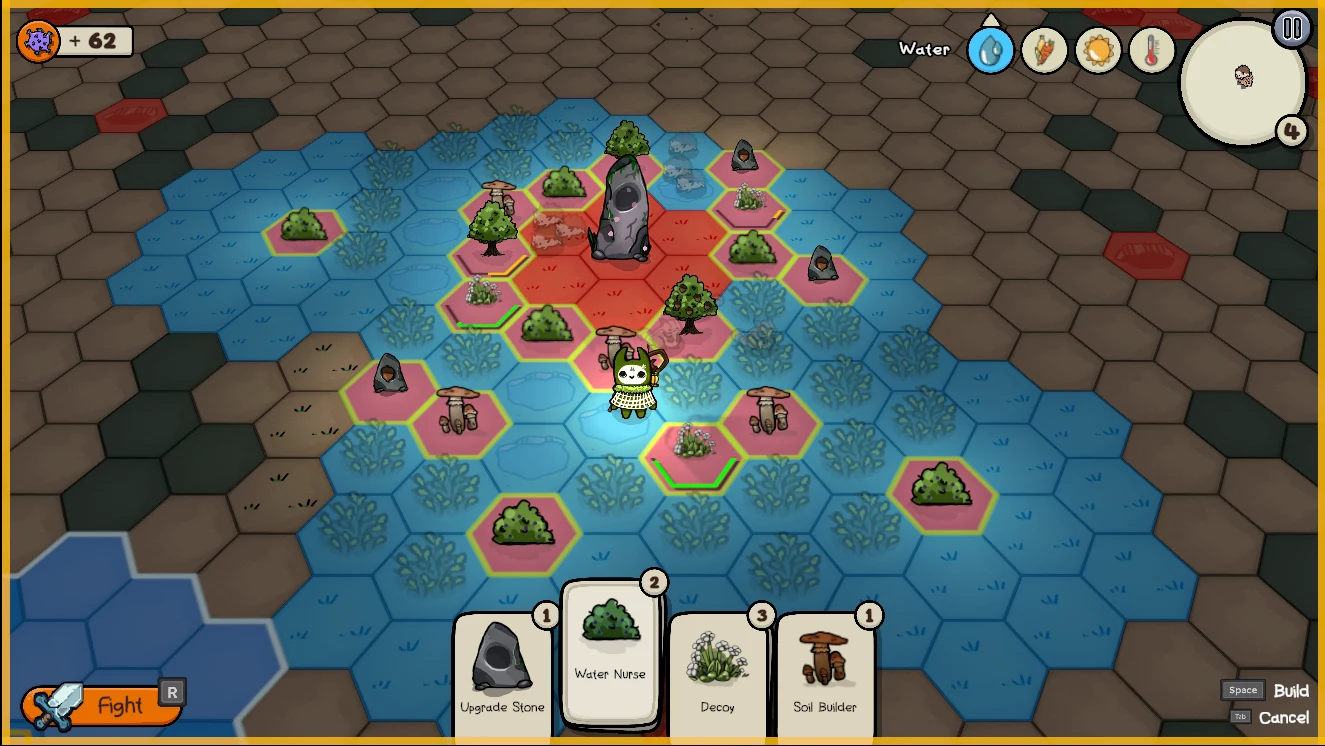
- Plants that need each other. The tutorial teaches that some plants require water and nutrition and some provide it, and the HUD tracks the same four tile stats I listed in the biodiversity document: water, nutrients, light and heat.
- A cost for monoculture. Plants of the same type clustered together spread infection, so variety pays because sameness hurts.
What changed
The first document said that if we overscoped we would protect the core features first, and this is what bent:
- Levels became runs. The game moved from separate levels on an overworld to an endless, roguelike structure with permanent upgrades between runs.
- The seed shop was implemented differently. My proposal was to spend seeds in the vault on upgrades. With six weeks and other priorities competing for the same hours, upgrades arrived in a different shape: you place an Upgrade Stone and protect it, and you pick permanent upgrades between runs.
- So was the end-of-level cataclysm. The monoculture test made it in, in a different form: infection.
- The green walls didn't make it. The idea of cooling a building by greening it was meant to be the bridge between the game's lesson and something a player could do in real life. We ran out of time before implementing it.
Post mortem
What worked. Starting with research. Playing more tower defense and reading the IGDA playbook gave me a vision for the game, and later, something to protect when scope shrank.
What I'd do differently. Two things. First, the first design document was light on how plants interact, because at the ideation stage that felt like a detail. It isn't one. Interactions are where this game lives, so next time they go into a proper table (who needs what, who provides it) in sprint one. Second, the green walls were the part of the design that turned the message into something a player can act on, and they were the part we ran out of time for. The part of a design that carries the message shouldn't be the part you cut when time runs out, so next time I'd build the smallest possible version of it in the first two sprints, before anything else can crowd it out.
What I took from it. This was the first design document I wrote for a whole team instead of for myself, and it changed how I write them: everything I used to keep in my head now has to go on the page, with the reasoning attached.
The originals are all public if you want to read them: the game design document, the biodiversity system and the seed economy. The two devlogs I wrote along the way are Researching tower defense before designing one and Design of Druid's Haven, and the game itself is on itch.io. Thank you for reading, and let me know what you think.