Designing the cards of Zvery
3 Oct 2023 · Zvery
Zvery is a dice-rolling creature card game inspired by Pokémon, and my friend Simon and I worked two years on it. We designed the game and its cards together, and I made all the art and laid out every card. So I was involved in both what cards did and how they looked.
Players start with one Zvery card and a matching adaptation card. They then take turns fighting wild Zvery. Players can either catch them or defeat them to get a reward. A small twist is that the opposing player controls the wild Zvery, so they can try to sabotage your plans. As Zvery fight they "mutate" by gaining extra ability cards.
So in total there are three card types: Zvery, adaptations (skills), and mutations (additional abilities).
Zvery
Bubbcat was among the first Zvery cards, and it started as a pencil sketch on paper. Here it is next to the latest version:
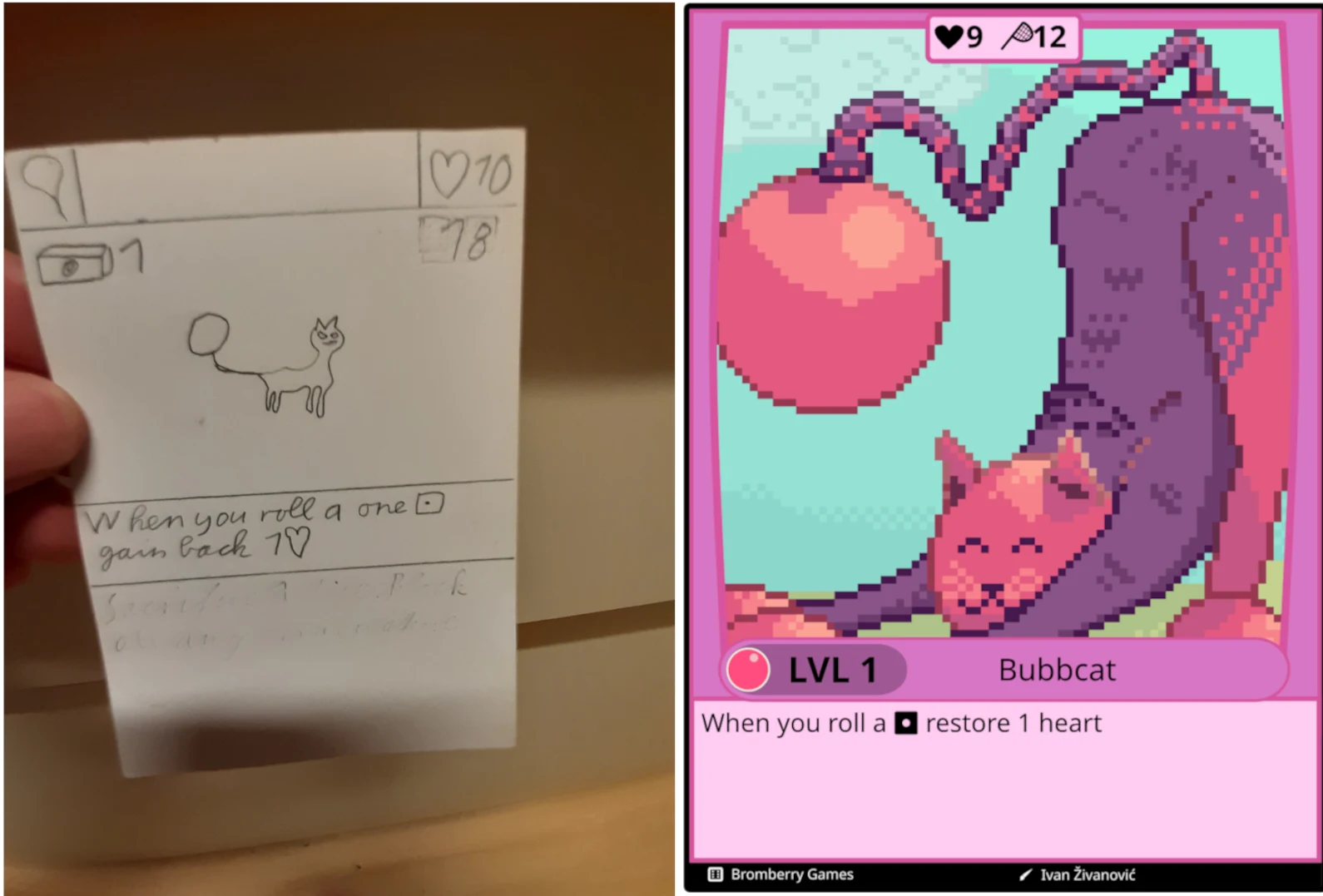
Overall, it's much easier to read and understand what's going on. The die icon is for readability, and while there is a case to be made that symbols actually increase cognitive load because they have to be learned, this one literally represents what a player sees, so it may even increase processing speed.
Catching
Catching in Zvery is a nifty mechanic where you add the current health with the catch value and roll your dice to get a number higher than the total catch value. So for example, Bubbcat starts with 21 total catch value, but as you fight and reduce its health, the catch value reduces.
For roll of five dice, the average result is around 17-18. Initially, its catch value was 18, which means that even at 1HP, it required an above average roll to catch. Since it is level 1, it should be very easy to catch, which is why we lowered it to 12.
Adaptations
Each Zvery gets a random "adaptation" of its type, a card that lists four skills. Will to Live shows the cost on the left and the effect to the right.
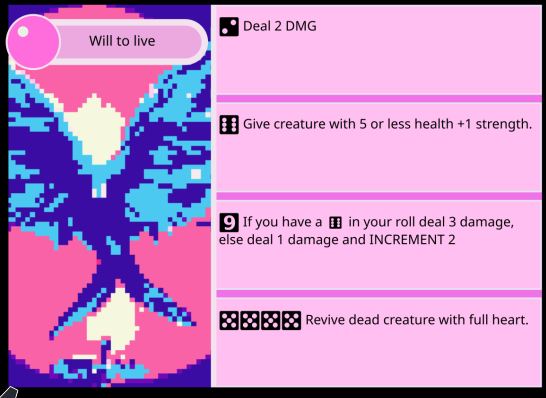
Skills can deal damage, manipulate your rolled dice, change Zvery stats and all kinds of effects. The harder a cost is to achieve through roll, the stronger the effect. For example, a single die deals 2 damage, whereas a 9 (which is any amount of dice adding up to 9 or more) can deal 3 damage. Most adaptations have their own kind of ultimate ability. This one lets you revive a creature for the cost of four 5s.
Mutations
The third and final card type are mutations. These cards have two effects that are active at different times.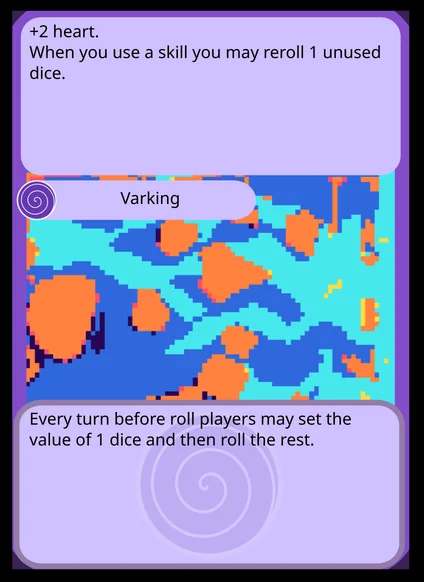
Mutations are laid out before and active during fights as "area effects", i.e. they create additional effects or conditions during a battle, which is the bottom effect. Varking for example lets players set a die before rolling their dice, a very powerful effect.
If the active player defeats the wild Zvery, they could choose to take this card and give one of their Zvery the top effect. Crucially, unlike adaptations which need to match the Zvery's typing, a mutation can be any type. This creates interesting interactions between their abilities.
The card designs
Every Zvery card type looks different. Form follows function, of course, but apart from allowing players to quickly distinguish the card type, it also serves a second purpose. Namely, adaptations and mutations are meant to be tucked behind the creature cards.
As you progress through the game, and as rewards get bigger, you start collecting a lot of cards. Soon, they're taking a lot of space and become overwhelming and one Zvery's cards may spread over to another's. To save a little space and to reduce the cognitive load of searching for the card you need as well as making card ownership more concrete, I designed the cards to be placed behind the Zvery.
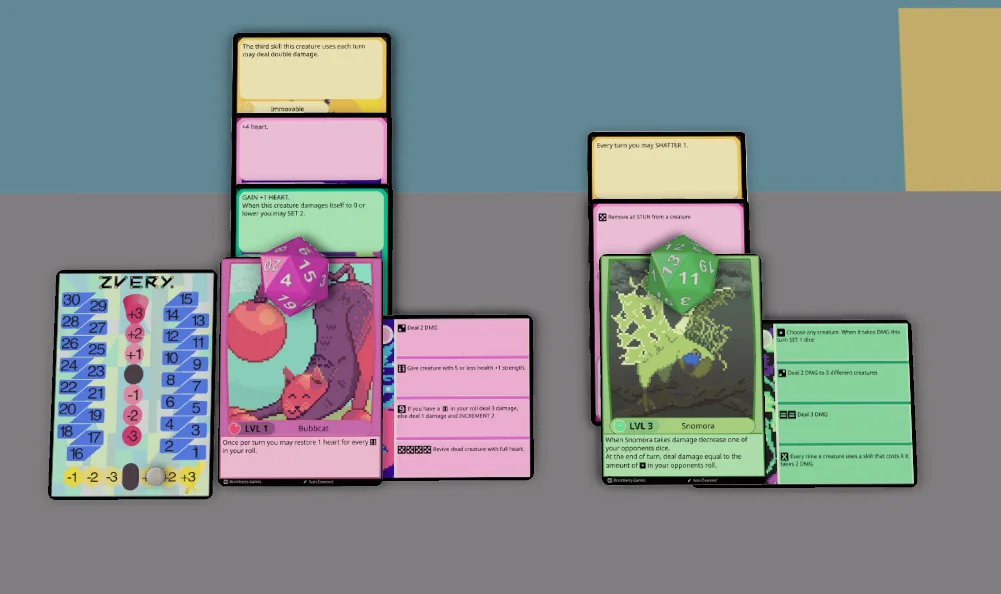
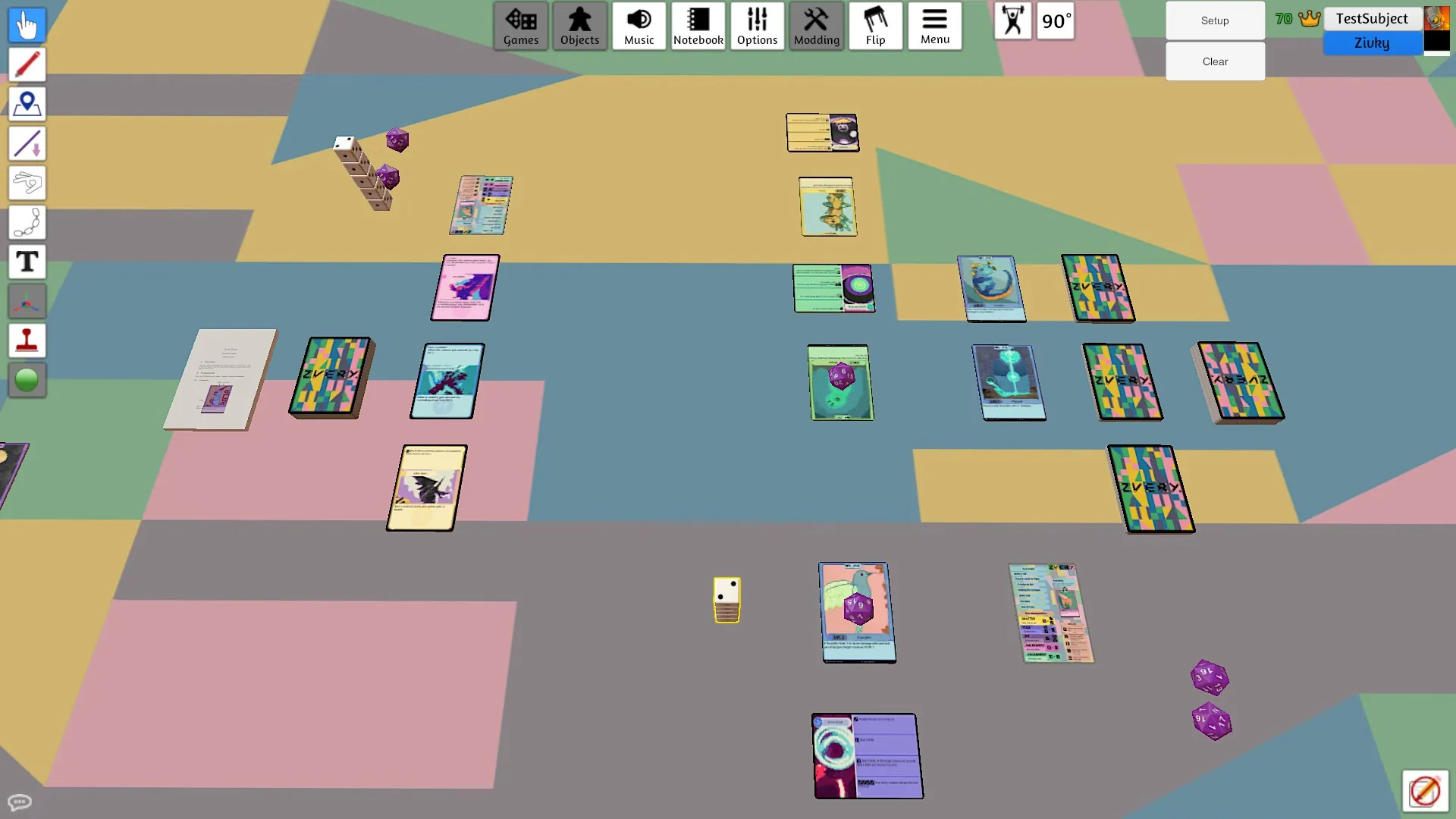
After a few turns, your board might look like this. Cleaner than if the cards were completely fanned out. Still, there's a lot of room to improve the design of the cards. Right now, they look pretty flat, some texture like gradients or other effects on the backgrounds would help make them more interesting. However, the design is partly a result from attempting to make it printable at home.
Playtesting in Tabletop Simulator
We also put a playable version on Tabletop Simulator, which is what we used to playtest it. Simon also scripted a lot of game behaviors so that setup and changing turns is easier.
Get it on the steam workshop here: https://steamcommunity.com/sharedfiles/filedetails/?id=2943320589